Like all plants that grow in a natural environment, vines and their development are heavily dependent on the weather. Sufficient rainfall, good soil quality and moderate sunlight are a guarantee for optimal plant growth - and make the winegrower happy. Unfortunately, however, it is not only the grapevine that is heavily dependent on the weather, but also its worst enemies: fungal diseases. This article is about the Fungal disease Peronospora.
Many winegrowers may still remember 2016, when one of the most common fungal diseases, downy mildew (Peronospora viticola, short: Pero), up to 50% of yield destroyed in some vineyards. A catastrophe. What had happened? After a mild winter, enormous amounts of rainfall of up to 430 litres hit the vineyards in January. In addition, there were fewer hours of sunshine than at any time in the last 35 years. The result: perfect weather conditions for the infection and spread of downy mildew on vines. But how exactly does this fungal disease behave, how does the weather favour the spread of this fungus and how can it be predicted?
Peronospora is the most dangerous of all vine diseases
The Downy mildew is one of the most common fungal diseases of grapevines in Europe, which makes it very difficult to reduce the use of copper in viticulture. The disease is caused by the fungus Plasmopara, which can infect apple and pear trees as well as grapevines.
Damage pattern of Peronospora
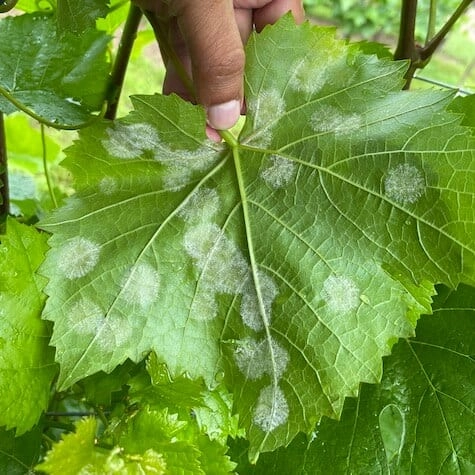
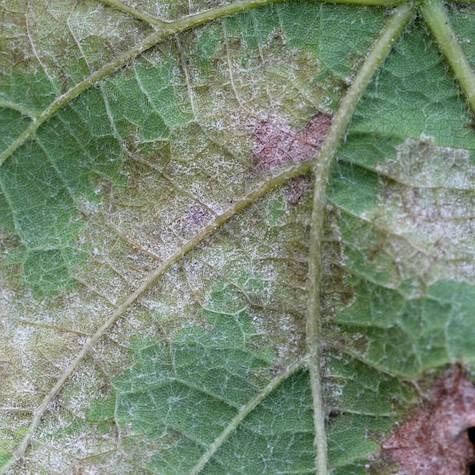
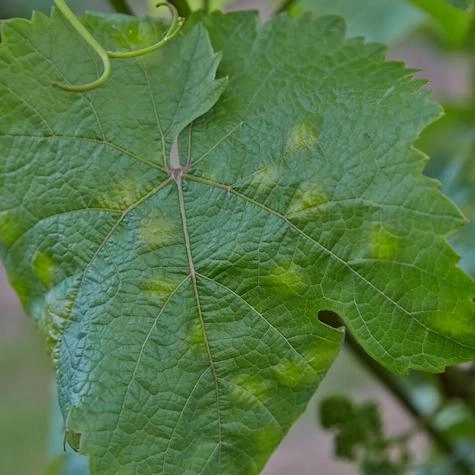
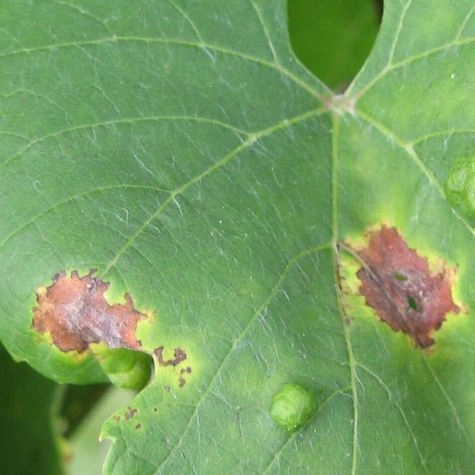
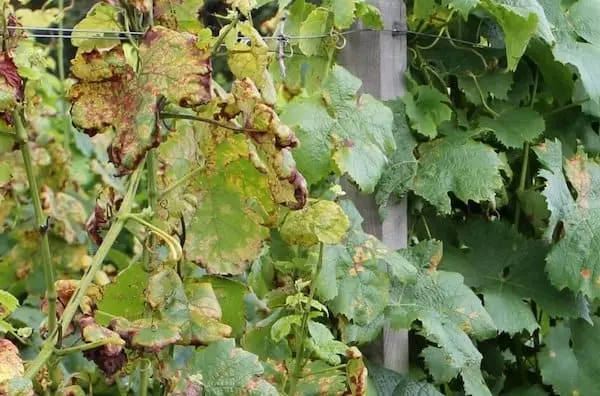
If the fungus has attacked the vines, the disease can be recognised by a white, furry coating on the underside of the leaves (Fig. 1 & 2). Another indication of an infestation are so-called „oil spots“, i.e. light-coloured, circular spots on the upper side of the leaves (Fig. 3 & 4).
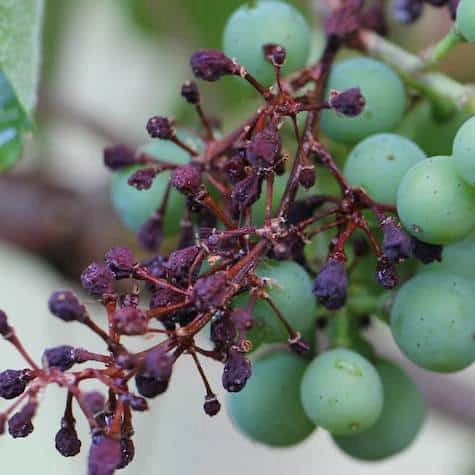
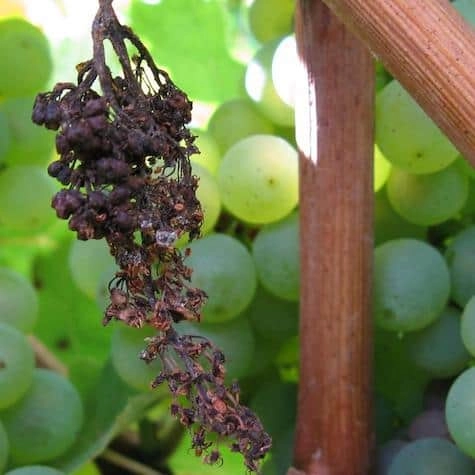
Once the disease has progressed, the infected leaves fall off. Fruit clusters can also be infected, which causes most yield losses. When infected, the grapes shrivel, turn brown and die (Leather berries, Fig. 5 & 6). This means that there is a risk of infestation at every stage of development, which is why Peronospora often described as the most dangerous of all vine diseases becomes.
Source: VineForecast field trials & HS Geisenheim
The weather determines the development of downy mildew on grapevines
The weather plays a role in all stages of Peronospora development. In order for a fungus to reproduce, it needs spores. In the case of downy mildew, these „winter spores“ overwinter in the soil and can survive for up to 10 years. The weather is a decisive factor in the germination of these spores. If the soil is wet and moist and the temperatures are mild (min. 10°C), the fungus germinates and sends out so-called „swarm spores“. Rain drops transport the swarm spores from the soil to the underside of the vine's leaves - like on a trampoline. The spores can then penetrate the plant through the stomata on the underside of the leaf and infect it.
In order for the fungus to develop its „summer spores“, which later lead to the disease characteristics described above, the fungus is now once again heavily dependent on the weather. Favourable conditions for spore formation are: 1. mild temperatures (min. 12°C), 2. high relative humidity or 3. high Leaf wetness (and 4. darkness, as formation only occurs at night). If these conditions are met, the disease begins to spread. The longer the weather prevents the formation of summer spores the more the disease will spread and the more The consequences are more serious for the winegrowers.
VineForecast: In the fight against Peronospora and Co.
The weather therefore contributes significantly to the development and spread of Peronospora. So if you want a Prognosis for the spread of downy mildew on grapevines Before we can venture into the future, we need to be able to reliably assess the weather situation. Could the catastrophic spread of the disease have been predicted in 2016? Of course, it is impossible to say exactly. What is certain, however, is that long-term observation of individual weather conditions such as temperature, rainfall and leaf wetness would have led to a relatively reliable estimate of the spread.
With our Forecasting system VineForecast we have specialised in detecting these infectious weather conditions at an early stage. In this way, we want to help ensure that crop failures caused by Peronospora are not as dramatic as they were in 2016. In future, we will be using our tool to rely on the reliable Forecast of Peronospora weather conditions, to stay one step ahead of the disease. Other diseases are also influenced by the weather. VineForecast therefore not only provides forecasts for Peronospora, but also for fungal diseases Oidium (powdery mildew) and Botrytis (grey mould rot, from 2022).