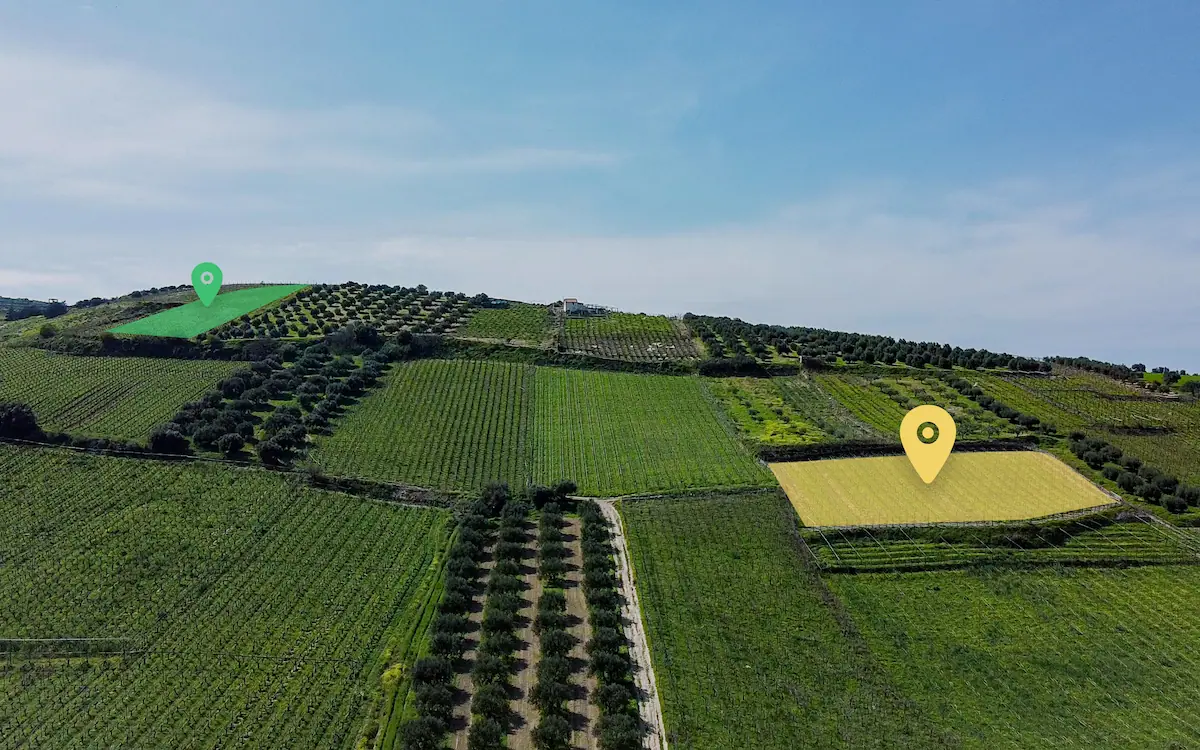
VineForecast creates forecasts for every vineyard of a winery without installing weather stations in the vineyards. You can find out how this works and the methodology behind the technology in this blog article.
Downscaling - regionalisation of the weather forecast
To understand how weather forecasts are actually produced, we first need to delve a little deeper into the subject. It is sometimes assumed that the nearest weather stations provide the weather forecast for the region. In reality, however, complex weather models are behind the weather forecast. The forecasts are calculated several times a day on supercomputers by national and international weather services such as the German Weather Service (DWD). A weather model is used to calculate the development of the weather over the coming hours and days.
Measured values serve as the starting point for weather forecasts
In somewhat simplified terms, a weather model divides the earth into so-called grid boxes. This can be imagined as a chessboard pattern. Each square of the chessboard can be assigned a value for temperature, air pressure or humidity. The laws of physics are then used to calculate how the various values develop over time. The smaller these grid boxes are, the higher the resolution of the weather model and the more realistically the influence of regional conditions, such as topography, can be modelled. This is because an average topography is used for each grid box. This means that topographical details disappear in models with a lower resolution. This difference can be clearly seen in Figure 1. The top image shows the topography of the Alps for a resolution of approximately 6 km x 6 km, while the lower image has a resolution of 2 km x 2 km.

Fig. 1: Two topography models compared: Above a resolution of 6km x 6km, below 2km x 2km
Before a weather model can be started, each grid box (“each square of the chessboard”) must be „filled“ with initial values. A large amount of measurement data from weather stations, weather balloons, aeroplanes or satellite data flows into the model for the initial values of the calculations.
The resolution of the weather models is crucial
However, the higher the resolution of a weather model, the more computing capacity is required. This is why most weather models currently have a horizontal resolution of 1km x 1km at best. For medium-term forecasts that extend several days into the future, however, the resolution is often significantly lower. For example, the DWD's ICON-EU model has a resolution of approx. 6km x 6km and extends up to 180 hours into the future. The higher-resolution ICON-D2 model has a resolution of approx. 2km x 2km, but only extends 48 hours into the future.
This resolution is often perfectly adequate for estimating the general development of the weather in the coming days. It becomes problematic when you are interested in the specific microclimate at a location. As the forecast values from the weather models tend to represent averaged values over a grid box, these can sometimes deviate significantly from the actual values at a specific coordinate. This problem is particularly pronounced if the forecast point is located in a region with a complex topography.
Regionalisation of weather data
In order to correct these errors in the forecast, meteorology and climate physics use a technique known as downscaling. This involves using statistical correlations between the topography and the microclimate in order to subsequently calibrate the weather forecast better to the local topography. Regionalisation is particularly important for all processes where even small differences can have a major impact. In viticulture, for example, a 2-3 hour difference in leaf wetness duration can have a major impact on the risk of infection with peronospora. This is why the weather forecasts from VineForecast are first regionalised before they are used in disease modelling.
An example of the regionalisation of the temperature at a height of 2 metres can be seen in Figure 2 below. On the left is the standard weather forecast from the DWD's ICON-D2 model (2km x 2km resolution), while the regionalised forecast from VineForecast (25m x 25m resolution) can be seen on the right. Incidentally, the Moselle valley is located in the south-east of the map and can be clearly seen in the regionalised forecast.

Fig. 2: Regionalised temperature: on the left a resolution of 2km x 2km, on the right 25m x 25m
Regionalisation of disease prognoses
Let's now take a look at the influence of regionalisation on the disease forecasts. To do this, we compare the infection forecasts for secondary infections with Peronospora between the standard weather forecast and the regionalised weather forecast, for example for 11 June 2021 for the region around Cochem on the Moselle.
The daily sum of the variable “degree hours with leaf wetness” is usually used as a measure of the risk of infection with Peronospora. This variable is calculated from the hourly values of temperature and leaf wetness, whereby all those temperature values are totalled over a day for which leaf wetness was present at the same time (see also here). If the daily total rises above a value of 50, a slight risk of infection is assumed. Strong infections are to be expected from values above 150.
If we now compare the disease forecast based on the standard weather forecast with the regionalised forecast in Figure 3, it becomes clear how strongly the regionalisation influences the disease forecast and how strongly the infection pressure varies over short distances. The use of a non-regionalised weather forecast as the basis for disease forecasts can, in case of doubt, lead to disease risks being greatly underestimated or overestimated.

Fig. 3: Regionalised disease prognoses: non-regionalised on the left, regionalised on the right