Why don't you need your own weather station for an accurate forecast?
In our last blog article, we explained how VineForecast adapts forecasts to the local conditions of a vineyard. With the help of the so-called Regionalisation VineForecast can detect small-scale differences in infection risks without weather stations.
In this blog article, we would like to address a question that we are often asked: How do you calculate forecasts if you don't have a weather station on site?
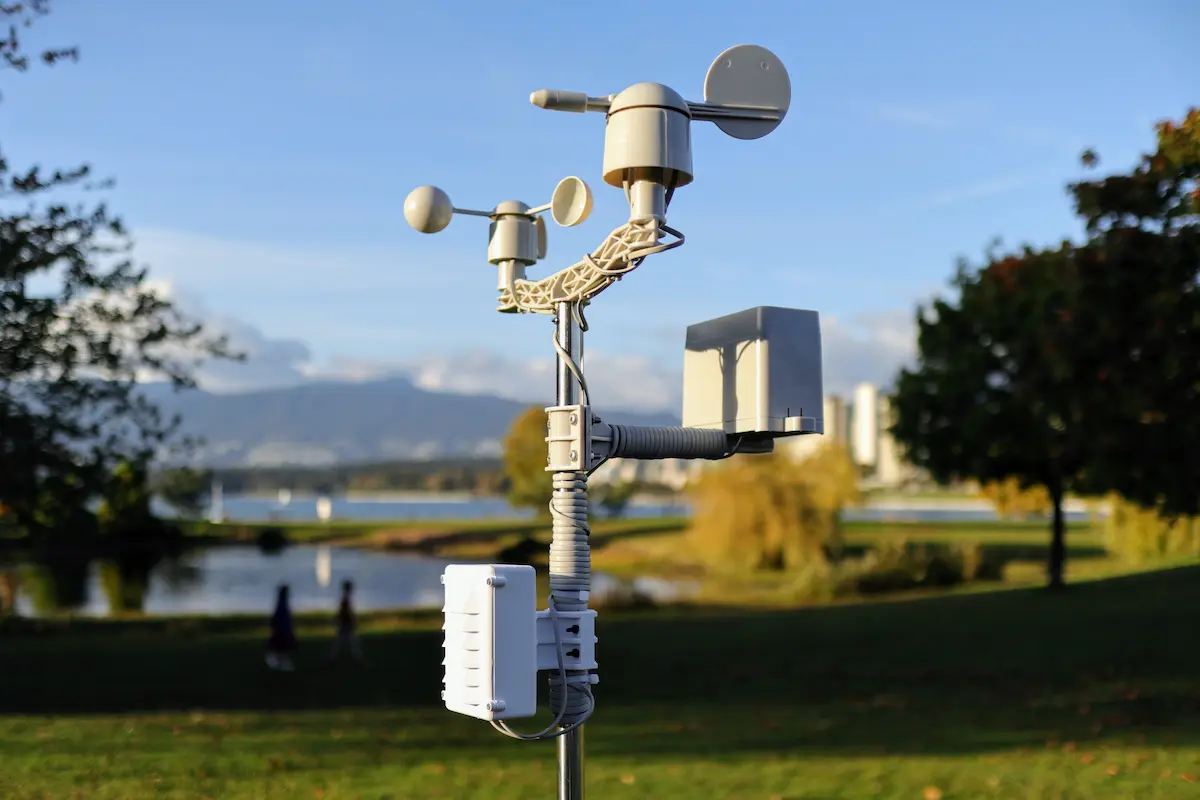
Weather stations measure - forecasts come from weather models
The most important information first: A weather station does not calculate a weather forecast.
Weather forecasts are issued by weather services such as the German Weather Service (DWD) in Offenbach or the National Oceanic and Atmospheric Administration (NOAA) in the USA. Giant supercomputers are needed to calculate these weather forecasts, on which the development of the weather in the coming days is calculated using a model of the atmosphere.
Measurement data from weather balloons, satellites or even weather stations continuously inform these weather models about the current state of the atmosphere. It is essential that measurement data comes not only from one region, but if possible from all over the world and from different layers of the atmosphere.
Europe's weather kitchen is located in North America
For example, the majority of the low-pressure systems that determine the weather in Central Europe originate off the east coast of Canada in the region around Newfoundland. From there, the areas of low pressure move eastwards across the Atlantic and cause precipitation on their warm and cold fronts in Europe.
Put simply, if weather models were not fed with data from North America, it would be virtually impossible to forecast the weather in Central Europe for several days. This would not change even if a weather station were set up every 100 metres in Europe.
VineForecast uses the data from the above-mentioned weather models and adapts them to the local conditions of a location. In this way, the effect of the general weather situation on the microclimate of a vineyard is estimated even more precisely.
Preventive plant protection requires predictions
In viticulture, weather forecasts are used primarily for plant protection against Oidium and Peronospora required. Most plant protection products only have a protective effect, i.e. the products must be applied to the plant before a potential infection occurs in order to effectively protect the plant material from infection. Although there are also curative agents, their effect is limited to a maximum of 48 hours after the infection event. The curative effect is often even less in the case of shoots and grapes (for more information click here).
Weather stations alone are purely measuring instruments and can only provide retrospective information about the course of the weather and disease pressure. For plant protection with preventive agents, however, you need information about the future in order to apply the plant protection products to the plant in good time before the threat of infection materialises. If a weather station provider also offers a weather forecast, this does not come from the weather station itself, but from the weather models described.
Advantages of VineForecast compared to weather stations
VineForecast specialises in the forecasting of weather and disease events. Using a weather station-free approach, VineForecast creates a customised solution for preventive plant protection without affecting the quality of the forecast. On the contrary, you can more favourable conditions obtain regionalised weather and disease forecasts for each field on your farm.
In addition, the subscription model means you remain flexible, have no high investment costs for weather stations and can benefit from synergies with the linked punch list and the Farm Management Platform benefit.
Please contact us for further information about our Contact form.